

Information from experts
8 January 2026

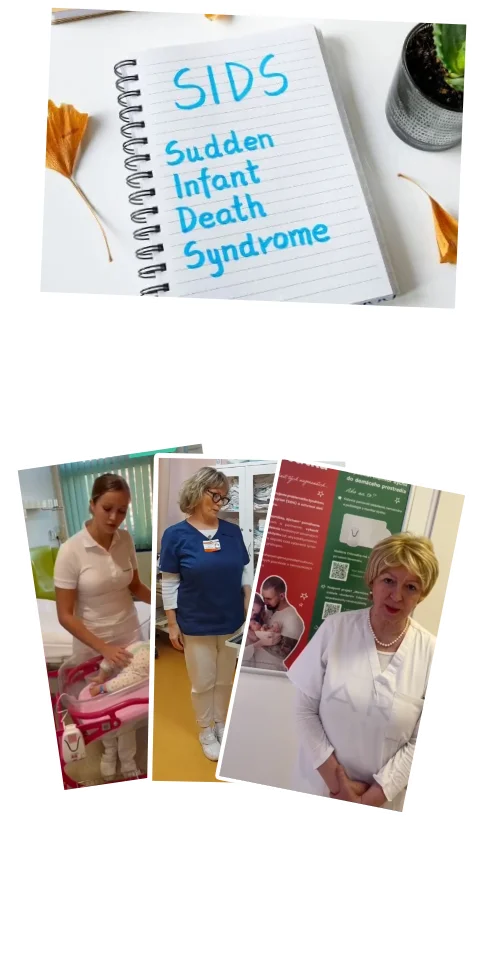
Essential information about SIDS
Sudden Infant Death Syndrome is every parent’s nightmare. It comes unexpectedly, without any symptoms or warning signs. It affects infants between 2 and 4 months of age, and its cause remains unknown to this day.
Sudden Infant Death Syndrome, known as SIDS, is the sudden and unexpected death of a baby during sleep in the crib. In Slovakia this diagnosis is rare and its incidence is falling below 0.2‰, yet it still calls for the utmost caution. SIDS is a race against time in which every second counts.
“Sudden Infant Death Syndrome (SIDS) is the sudden death of an infant associated with sleep that cannot be explained by a post-mortem examination. It is preceded by a life-threatening event known as ALTE (Apparent Life-Threatening Event), during which it is still possible to help the baby. In this state the baby is pale, sometimes cyanotic, not breathing, and we may observe floating eye movements and weak muscle tone, which makes infants in this condition resemble rag dolls,” says paediatrician MUDr. Monika Michňová.
Why apnoea monitors matter
MUDr. Adriana Uhríková, physician – Specialist
Paediatric Department
Penta Hospitals Galanta Hospital
Apnoea monitors play an exceptionally important role in infant care. In her words, they quite literally help save children’s lives in practice. They are closely linked to Sudden Infant Death Syndrome (SIDS), which most parents have at least heard of.
Their value is not limited to monitoring high-risk groups such as premature infants. MUDr. Uhríková stresses that apnoea monitors are also warranted at home—even for completely healthy babies. They are not an unnecessary scare for parents, because SIDS can also occur in infants with no known risk factors.
Parents cannot watch their baby every second without interruption. That is precisely where an apnoea monitor makes a crucial difference—it continuously tracks even the slightest movements and can detect a pause in breathing that a parent might miss with the naked eye.
The doctor also shares her personal experience as a mother. Even though she had a healthy baby, she chose to use an apnoea monitor. In one case the device did signal a false alarm, but as first-time parents she and her partner realised how much certainty and the ability to respond immediately matter.
In conclusion, MUDr. Adriana Uhríková clearly recommends using apnoea monitors even for healthy newborns, because their benefit in prevention and early detection of problems is undeniable.
Consent is required to display this content
This content loads a third-party service that may store cookies. Please enable the “Map, videos and social media” category in settings.
Using a breathing monitor correctly and responding to an alarm
Bc. Denisa Cichá
Neonatology Department
Penta Hospitals Humenné Hospital
In the video, Bc. Denisa Cichá focuses on safe infant sleep when using a breathing monitor. She explains that the monitor consists of a sensor pad placed under the mattress and a signalling unit with a light and acoustic signal. She emphasises placing the baby so that their whole body lies on the pad, which helps prevent false alarms.
She stresses that the signalling unit should always be switched on after the baby is placed in the crib, and that its function should be checked via the green light signal. If the baby is positioned incorrectly or the batteries are flat, the device may signal with a red light.
The video also describes the alarm sequence when breathing is disrupted—from a flashing red light and a gradual sound alert through to a loud alarm. In that case, check the baby’s face colour and breathing. If the baby is not breathing, resuscitation must be started immediately.
You can find more practical information and the exact procedure in the video.
Consent is required to display this content
This content loads a third-party service that may store cookies. Please enable the “Map, videos and social media” category in settings.
Experience from practice: when a breathing monitor saved a life
MUDr. Edit Rajzák, head physician
Paediatric Department
Penta Hospitals Dunajská Streda Hospital
MUDr. Edit Rajzák talks about her long-standing cooperation with Nadácia Križovatka.
She describes cases from practice in which an apnoea monitor signalled a problem in time, mothers responded, and the children were brought to hospital where they could receive help. She also recalls tragic experiences from a time when a breathing monitor was not available and a sudden infant death occurred at home.
She notes that today, for children from high-risk groups or for those with problems during pregnancy or after birth, they prefer and offer an apnoea monitor. She specifically mentions the Babysense apnoea monitor, which she considers beneficial.
She closes by thanking Nadácia Križovatka for the cooperation and expressing hope that it will continue for the sake of protecting children’s lives.
Consent is required to display this content
This content loads a third-party service that may store cookies. Please enable the “Map, videos and social media” category in settings.
Breathing monitors as “guardian angels” of newborns
Doc. MUDr. Darina Chovancová, CSc., head of clinic
M. Rusnák Neonatal Clinic, SZU and UNB
St. Cyril and Methodius Hospital, Bratislava
In the interview, Doc. MUDr. Darina Chovancová, CSc. expresses gratitude for breathing monitors, which are welcome on neonatal wards. She emphasises that the first moments after birth—when the baby cries and starts breathing—are highly significant not only for parents but also for healthcare professionals.
She points out that the first days and weeks can involve complications in which breathing disorders may be life-threatening. Breathing monitors are, in her words, “guardian angels”, because they make it possible to see whether the baby is breathing and immediately signal a problem if breathing stops. That allows staff to intervene at once and protect the child from a lack of oxygen, which is critical for the brain.
Consent is required to display this content
This content loads a third-party service that may store cookies. Please enable the “Map, videos and social media” category in settings.
A signal for parents when breathing stops
MUDr. Veronika Cipková, physician
Neonatology Department
University Hospital Nitra
MUDr. Veronika Cipková explains that the breathing monitor alarm is not meant to frighten parents, but to alert them to a possible problem. She notes that the monitor tracks the baby’s breathing and, if it stops, immediately triggers an alarm so parents can respond quickly.
She stresses that when the alarm sounds, you should check the baby’s face colour and chest movement. If the baby is pink and breathing, it is a false signal. If the baby is not pink and is not breathing, resuscitation must be started at once.
Consent is required to display this content
This content loads a third-party service that may store cookies. Please enable the “Map, videos and social media” category in settings.


Share your experience and help us grow.